


Media Content
Resources, Testimonials, and More

“They made it happen!” — A School’s Experience with LAF SLS' Financial Department
Hear how Special Education Director, Miss Mizell describes LAF Sign Language Solutions’ commitment to flexibility, collaboration, and fast support. From financial adjustments to immediate responses, LAF SLS made partnering easy and stress-free.
If you’re a SPED director or school administrator, we’d love to partner with you to ensure every Deaf and hard-of-hearing student gets the access they deserve. Visit www.lafsls.com to connect with our team and explore how we can support your program as well as receive free information on how to access state grants for your students.
Follow us on Facebook, Instagram, and LinkedIn and don’t forget to subscribe to our YouTube channel for more free videos to support Deaf and hard-of-hearing students!

NAIE Code of Ethics Tenet 3: Maintain Confidentiality
In this video, LAF SLS explores Tenet 3 of the Educational Interpreters’ Code of Ethics: maintaining confidentiality.
We’ll look at how confidentiality applies to student information, IEPs, 504 plans, professional conversations, and social media.
Learn how using good judgment and discretion can help protect student privacy and create a respectful, supportive environment.

Virtual Vs In-Person Interpreting: Which Should You Choose?
Can virtual sign language interpreting be as effective as in-person support?
This video explores how both virtual and in-person interpreting provide deaf and hard-of-hearing students with full communication access. Learn how each approach supports participation, engagement, and collaboration in the classroom.


Educational Interpreters’ Code of Ethics: 📚 Tenet 2: Provide Language Access
In this video, LAF Sign Language Solutions explores Tenet 2 of the Educational Interpreters’ Code of Ethics (NAIE): ensuring students have full communication access in the classroom.
Learn how interpreters and educators work together to support deaf and hard-of-hearing students through clear roles, strong collaboration, and a focus on language access and development.

Educational Interpreters’ Code of Ethics: 📚Tenet 1: Respect Student Autonomy
In this video, LAF Sign Language Solutions highlights a key resource from the National Association of Interpreters in Education—the Educational Interpreters’ Code of Ethics.
💡 Focus: Student Autonomy
-Students have the right to choose how they communicate
-Interpreters adapt as students grow and build self-advocacy skills
-Encouraging students to speak up and ask for support builds independence
-Educators play a key role by supporting and reinforcing student voice
Empowering Deaf and hard-of-hearing students to advocate for themselves helps set them up for lifelong success.
📌 Subscribe for more resources, tips, and support: lafsls.com
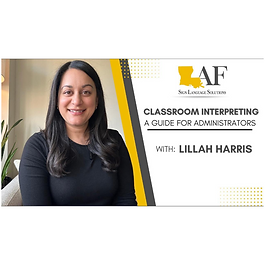
Classroom Interpreting: A Guide for Administrators
In this video, LAF SLS shares key insights from a resource by Dr. Brenda Schick (Gallaudet University), designed to help administrators build inclusive, effective learning environments.
Learn:
-The true role of the educational interpreter
-Why inclusion in IEPs matters
-How proper support (prep time + breaks) impacts student success
Small shifts. Big impact.

NDC Tips: Working Effectively with an Interpreter in the Classroom
Working with a sign language interpreter for the first time?
In this video, we share practical tips and key reminders from the National Deaf Center to help educators collaborate effectively in the classroom with interpreters and their deaf or hard-of-hearing student.

LAF SLS' Management Team Retreat Highlights
Experience the energy of the LAF Sign Language Solutions team retreat in Wilmington, NC. This video highlights a few days of connection, collaboration, and fun as our team stepped away from the day-to-day to recharge, reflect, and focus on our mission through laughter, learning, and thoughtful planning.
👉 Watch how we strengthened our bonds and sharpened our vision for supporting Deaf and hard-of-hearing students through high-quality virtual interpreting services.

Educating Deaf Students: 3 Things to Know Part 3: Clarifying the Roles of Interpreter, Tutor, and Teacher
While it takes a village to raise a child, it’s the strength of a united educational team that ensures every student learns, grows, and thrives. However, when professional roles become blurred, it can hinder a student’s academic and developmental progress.
In Part 3 of the series "Educating Deaf Students: 3 Things to Know", Katie Johnson, Lead Interpreter, addresses the importance of clarifying the roles of an interpreter, a tutor, and a teacher to support student development.